Posted by Sonitha Mandava on | Comments Off on How Vibratory Feeders Work: A Complete Guide for Manufacturers
If you’ve ever wondered how manufacturers move, sort, and orient thousands of parts per hour with perfect consistency, the answer is often a vibratory feeder. This guide breaks down how these systems work, their components, when to use them, and the industries where they make the biggest impact.
What Is a Vibratory Feeder?
A vibratory feeder is an automated device that uses vibration to transport and orient parts along a controlled path. Unlike belt feeders or conveyors, vibratory systems move parts through rapid oscillation, giving manufacturers high throughput with minimal mechanical wear.
These systems can take the form of:
Vibratory bowl feeders
Linear vibratory feeders
Vibratory conveyor feeders
Custom part-handling systems
Key Components of a Vibratory Feeding System
Drive Units
The drive unit generates the oscillation that moves parts along the tray or bowl. By adjusting vibration frequency and amplitude, operators can fine-tune feed rate and directional flow.
Feeder Bowl or Tray
This is where material sits. Bowl feeders are used for sorting and orienting small components, while linear trays are ideal for straight-line movement.
Controller System
Modern feeders use digital controllers for:
Speed adjustments
Load compensation
Quiet operation
Energy management
How Vibratory Feeders Work
The Vibration Mechanism
Vibratory feeders rely on rapid, repeated micro-throws of material. Each vibration lifts parts slightly and moves them forward in a controlled direction. The motion may be mechanical, electromagnetic, or pneumatic depending on the design.
Orientation and Part Flow
In bowl feeders, the track geometry ensures parts reach the correct orientation before exiting. Rails, cut-outs, and tooling features guide components into consistent alignment for downstream automation.
Benefits of Vibratory Feeders
Energy Efficiency
Electromagnetic drives consume less energy than traditional mechanical systems, making them cost-effective for long production shifts.
High Throughput
Because movement is continuous, vibratory feeders maintain consistent feed rates—ideal for high-volume applications.
Precision Part Orientation
Bowl feeders can sort, orient, and queue components with remarkable repeatability.
Vibratory Feeder Applications Across Industries
Vibratory feeders appear in nearly every manufacturing sector, including:
Electronics
Medical devices
Automotive assembly
Packaging
Food processing
Fasteners and hardware
Choosing the Right Vibratory Feeder
Consider:
Part size and geometry
Required feed rate
Desired orientation
Environmental conditions
Integration with conveyors, robots, or inspection systems
Manufacturers often select between bowl feeders for orientation or linear feeders for distribution or accumulation.
FAQ
What is a vibratory feeder used for? To move, orient, or sort components automatically.
How does a vibratory feeder bowl orient parts? Through tooling features such as rails, cutouts, and track geometry.
Are vibratory feeders reliable? Yes. Their low wear and simple mechanics make them highly dependable.
What industries use vibratory feeders? Automotive, electronics, medical devices, food processing, and more.
Looking to automate part handling with precision? Contact us to explore modern vibratory feeder solutions engineered for speed, consistency, and efficiency, built for the next generation of manufacturing.
Posted by Sonitha Mandava on | Comments Off on Step Feeders vs. Vibratory Feeders: Choosing the Right System
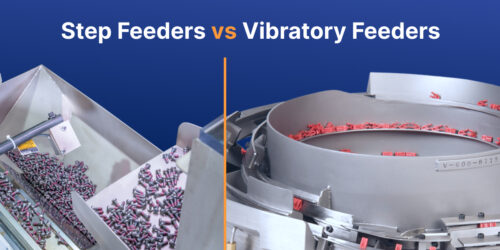
Step Feeders vs. Vibratory Feeders: Which Is Better for Your Production Line?
When engineers evaluate parts feeding systems, two solutions often top the list: step feeders and vibratory feeders. Both serve the same essential purpose – orienting and delivering parts efficiently. However, they do so in very different ways. Understanding the differences between these systems can help you choose the right solution for your specific part geometry, cleanliness requirements, and production goals.
How Vibratory Feeders Work
Vibratory bowl feeders use controlled vibration to move and orient parts along a spiral track inside a bowl. Each part is guided through tooling designed to ensure proper orientation before exiting the feeder into the next stage of the automation system.
Advantages of Vibratory Feeders
High-Speed Throughput: Ideal for high-volume production where cycle times matter.
Flexible Orientation & Multi-Part Capability: Custom tooling allows one bowl to handle multiple part styles or complex geometries.
Handles Large or Oily Parts: Properly designed bowls can reliably feed heavier or lubricated parts that other systems struggle with.
Cleanroom-Compatible Designs: Vibromatic engineers frequently develop vibratory systems for controlled environments, using advanced enclosures and materials to meet cleanroom standards.
Compact & Durable: Efficient footprint with long-lasting operation and low maintenance needs.
With the right engineering, vibratory bowls can handle a much wider range of parts and environments than most realize—including those traditionally reserved for step feeders.
How Step Feeders Work
Step feeders use a stepwise motion of precisely machined plates to lift and gently advance parts from a bulk supply to an orientation mechanism. Instead of vibration, mechanical indexing controls part flow.
Advantages of Step Feeders:
Gentle Handling: No vibration means less wear, noise, and part damage—ideal for cosmetic or fragile parts.
Clean Operation: Preferred for medical, pharmaceutical, and cleanroom environments where dust or oil contamination is unacceptable.
Consistency with Heavy or Oily Parts: Step action ensures smooth, reliable feeding when vibration would fail.
Step feeders are well-suited for moderate-speed lines prioritizing part protection or noise reduction—but their slower feed rates and limited flexibility make them a niche solution compared to vibratory systems.
Choosing Between Step Feeders and Vibratory Feeders
Factor
Vibratory Bowls
Step Feeder
Speed
Very High
Moderate
Part Range
Small to Large, Multiple Part Types
Limited Size Range, Single Part Type
Industry Application
Across all industries
Specialized niche application
Noise Level
Higher
Very Low
Part Sensitivity
Suitable for most parts with proper tooling
Gentlest possible handling
Cleanroom Compatibility
Excellent with proper engineering
Excellent
Oily/ Heavy Parts
Yes – with engineered solutions
Yes – but slower
Multi-Part Capability
Yes
Yes
Maintenance
Periodic tuning and cleaning
Minimal but slower output
If your goal is to move parts quickly, consistently, and with precision, a vibratory feeder system remains the gold standard. When quiet operation and part protection are the top priorities, step feeders can be a strong complement.
Hybrid Applications
Many modern automation lines use a combination of both systems: a step feeder for gentle bulk presentation followed by a vibratory track or bowl for precise orientation. This hybrid approach leverages the strengths of both designs – speed and precision without sacrificing cleanliness or part integrity.
Ready to find a system that fits your needs?
Whether your priority is speed, noise reduction, or gentle part handling, understanding the trade-offs between step feeders and vibratory feeders ensures your automation performs reliably from day one.
For over 70 years, Vibromatic has engineered both vibratory parts feeding systems and step feeder systems for manufacturers across automotive, medical device, consumer goods, and packaging industries, helping teams overcome bowl jams, part damage, and integration delays.
Posted by Doug Daubenspeck on | Comments Off on Understanding Vibratory Feeders: An Introductory Overview
A vibratory feeder is a mechanical device that conveys bulk materials along a vibrating conveyor or feeder tray. It is commonly used in industries such as mining, pharmaceuticals, food processing, and automotive manufacturing for tasks such as feeding raw materials, sorting, and packaging. It offers precise control over the feed rate and can handle a wide range of materials, from fine powders to large chunks of material.
This blog will discuss the basics of a vibratory feeder, including how it works and the different types available.
Working Principles of Vibratory Feeders
A vibratory feeder operates based on a combination of mechanical and electronic principles, ensuring the smooth and controlled movement of parts and materials. Explore its working principles below:
Vibration
Vibratory feeders generate controlled vibrations that move materials along the feeder tray. These vibrations can be adjusted in frequency and amplitude to suit the specific material being handled and the desired feed rate. This ensures a consistent and controlled flow of materials or parts, allowing them to move in the desired direction and orientation.
Electromagnetism
A vibratory feeder utilizes electromagnets to create the vibrations necessary for material movement. It features an electromagnetic drive that consists of a magnet and a coil. When an electric current passes through the coil, it generates an oscillating magnetic field that interacts with the feeder’s metal tray, causing it to vibrate. Adjusting the electrical input allows precise control over the feeder’s vibration intensity and frequency.
Control Systems
Modern vibratory feeders have advanced control systems that allow for fine-tuning the feeding process. They include sensors and feedback loops that adjust the vibration parameters in real time, ensuring optimal performance and minimal downtime.
Mechanical Design
The feeder bowl and track design are crucial for ensuring that parts move in the desired orientation. The bowl’s shape, track design, and the addition of various tooling elements all contribute to the efficient handling of parts. Moreover, custom designs tailored to specific parts and materials enhance the feeder’s effectiveness.
Types of Vibratory Feeders
Vibratory feeders come in various types, each designed to handle specific applications and materials.
1. Vibratory Bowl Feeders
Traditional vibratory feeders use a combination of electromagnetic drives and mechanical design to move parts along a track. These versatile feeders can handle various materials, making them ideal for industries such as automotive, electronics, and pharmaceuticals.
2. Flex Feeders
Flex feeders are designed to handle various parts or components with different shapes, sizes, and orientations. They use flexible, interchangeable tracks to accommodate different materials, making them ideal for applications requiring frequent changeovers.
3. Step Feeders
Step feeders use a series of steps or platforms arranged in an ascending pattern to elevate parts to the desired height and propel them forward along the feeder track. The steps guide parts into the correct position, making them suitable for applications that require precise orientation or positioning.
4. Centrifugal Feeders
Centrifugal feeders use a spinning disk or bowl to generate a centrifugal force that moves parts outward. They are suitable for high-speed applications and can handle various parts, shapes, and sizes. This type is often used in conjunction with vibratory feeders for part pre-orientation.
Vibromatic Co.: Your Partner for Cutting-Edge Feeder Solutions
Vibromatic Co. has been a pioneer in the parts-feeding industry since 1956. We offer a comprehensive range of feeders, including vibratory bowl feeders, linear systems, floor feeders, step feeders, and centrifugal feeders. In addition, we provide custom solutions designed for optimal performance to meet diverse industrial requirements.